
How to Teach Teens About Money: a 12-week plan for parents (UK & US)
A 12-week kitchen-table plan to teach teens about money: income, budget, saving, banks, interest, subscriptions, scams, credit, tax, insurance, investing.
 Mark · dad of three, built Novara
·
Published
·
Money skills for teens
In summer 2026 I sat at the kitchen table with my three daughters, 13, 15 and 17, for about an hour a day and talked about money. Not lectures: one topic, one real example, one thing to do. By the end of the summer they were not reciting definitions; they were arguing with me about interest rates. This is that plan, tidied into twelve weeks, one topic a week, with the terms given for both the UK and the US where they differ.
The 12 weeks at a glance
| Week | Topic | The one exercise | UK / US terms |
|---|---|---|---|
| 1 | Income | Read a real payslip together | PAYE payslip / pay stub |
| 2 | Budget | Track every penny for 7 days | same |
| 3 | Saving | Set one goal with a picture and a date | same |
| 4 | Banks | Open or review their own account | FSCS £120,000 / FDIC $250,000 |
| 5 | Interest | Run the compound interest calculator | same |
| 6 | Subscriptions | The annual-cost audit | same |
| 7 | Scams | Spot the fake message | same |
| 8 | Credit | Cost out a phone on finance vs. saved cash | credit reference agencies / credit bureaus |
| 9 | Tax | Work out tax on a first job | HMRC, Personal Allowance / IRS, standard deduction, W-4 |
| 10 | Insurance | Price the phone insurance | same |
| 11 | Investing | Explain a fund with a pizza | ISA, Junior ISA / Roth IRA, custodial account |
| 12 | The plan | Budget a month of living alone | same |
Weeks 1 to 4: where money comes from and where it lives 💶
Week 1: Income
Start with a payslip, yours if you are comfortable (cover the totals) or a sample. Gross at the top, deductions in the middle, net at the bottom. The sentence to land: “Gross is not net.” If your teen has a Saturday job, use theirs. In the UK the minimum wage from April 2026 is £8.00 an hour for under-18s and £10.85 at 18 to 20 (GOV.UK); in the US the federal floor is $7.25 and most states set more (DOL). Ask: how many hours is that phone?
Week 2: Budget
Just a notes app and one rule: write down everything you spend for seven days. On day eight, sort it into needs, wants and “I don’t remember buying that”. The third category is the lesson. Then agree a simple split for their pocket money or allowance; for how much that should be, see Pocket Money Guide 2026 (UK) or Allowance by Age 2026 (US).
Week 3: Saving
No teenager saves “for the future”. They save for the festival ticket. Pick one goal, put a picture on it, work out the weeks. A savings pot with a name in their banking app does the rest.
Week 4: Banks
Open the account together, then go through the app: balance, statement, how to freeze the card. Then answer the question every teen asks: what if the bank fails? In the UK the FSCS protects up to £120,000 per person per bank (FSCS); in the US the FDIC covers $250,000 per depositor per bank (FDIC).
Weeks 5 to 8: the quiet costs 📈
Week 5: Interest
Do the sums once and they stick. £1,000 (or $1,000) at 3% a year is 1,030 after a year, about 1,344 after ten years, 1,806 after twenty and 2,427 after thirty, without adding a penny. The sentence: “Money you leave alone works for you, and the interest earns interest.”
Week 6: Subscriptions
The annual-cost audit. List every subscription in the household, theirs included, and multiply by twelve. A 12.99 game pass is nearly 156 a year, roughly half a year of pocket money. The question to teach: “What does that cost per year?” Cancel two things together. Repeat every quarter.
Week 7: Scams
Teens are targeted precisely because they are online and inexperienced: fake delivery texts, “your account has been locked”, a friend’s hacked account asking for a quick transfer, job offers that need a fee up front. Play spot-the-scam with real screenshots. Three rules: nobody legitimate asks for a password or a code, urgency is a warning sign, and if you are not sure, hang up and call back on a number you looked up yourself.
Week 8: Credit
The first real contracts arrive at 18: a phone on finance, an overdraft, buy-now-pay-later at every checkout. Explain that a credit file follows them: in the UK the credit reference agencies, in the US the credit bureaus, record what they borrow and whether they pay on time, and a missed phone bill at 19 shows up when they apply for a flat or a car loan at 25. Then do the exercise: a 600 phone in 24 instalments with interest versus 600 saved in ten months. The sentence: “Paying later means paying more.”
My 17-year-old pushed back on overdrafts: “That’s only for emergencies.” Then she looked up the overdraft rate at the bank she was about to join. It was the first time she had voluntarily looked up an interest rate.
Weeks 9 to 12: the adult stuff 🎓
Week 9: Tax
Use their first job or a made-up one. UK: the standard Personal Allowance is £12,570, and income above it up to £50,270 is taxed at the basic rate of 20% (GOV.UK); most teens earn less than the allowance and pay no income tax, though they may see National Insurance on a payslip. US: the 2026 standard deduction for a single filer is $16,100 (IRS), so a teen earning less owes no federal income tax and can usually write “Exempt” on Form W-4, but Social Security and Medicare (6.2% + 1.45%) come out of every paycheck regardless (IRS Topic 751). Either way, the sentence is the same: what is taken out is not lost; it pays for roads, schools and one day their pension.
Week 10: Insurance
Insurance is the hardest idea for a teen because it is paying for something that might not happen. Make it concrete: price the insurance on their phone, then ask what they would do if it broke tomorrow. Compare it with just putting the same monthly amount in a “phone fund”. There is no right answer; the point is that they can now see the trade-off.
Week 11: Investing
Explain a fund with a pizza: instead of buying one whole company, you buy a slice of hundreds. Then show the long game. At 5% a year, 100 a month for 40 years is roughly 150,000, of which only 48,000 was paid in; the rest is growth. Then the wrappers. UK: a Junior ISA takes up to £9,000 a year until 18, when it becomes an adult ISA with a £20,000 annual allowance (GOV.UK). US: a custodial Roth IRA is available as soon as your teen has earned income, with contributions capped at their taxable compensation up to $7,500 in 2026 (IRS); a custodial brokerage account (UTMA/UGMA) works for gifts. Be clear that investments can fall as well as rise, and that this is education, not advice.
Week 12: The plan
The finale is a game: budget one month of living alone in your town. Rent for a real room from a listings site, utilities, food, phone, transport, insurance. When they finish, two things click: why saving is not a hobby, and why you were so annoying about subscriptions.
One topic a week is plenty. The effect comes from repetition in daily life: the same question at the checkout, the same look at the statement, the same subscription audit every quarter.
How Novara helps
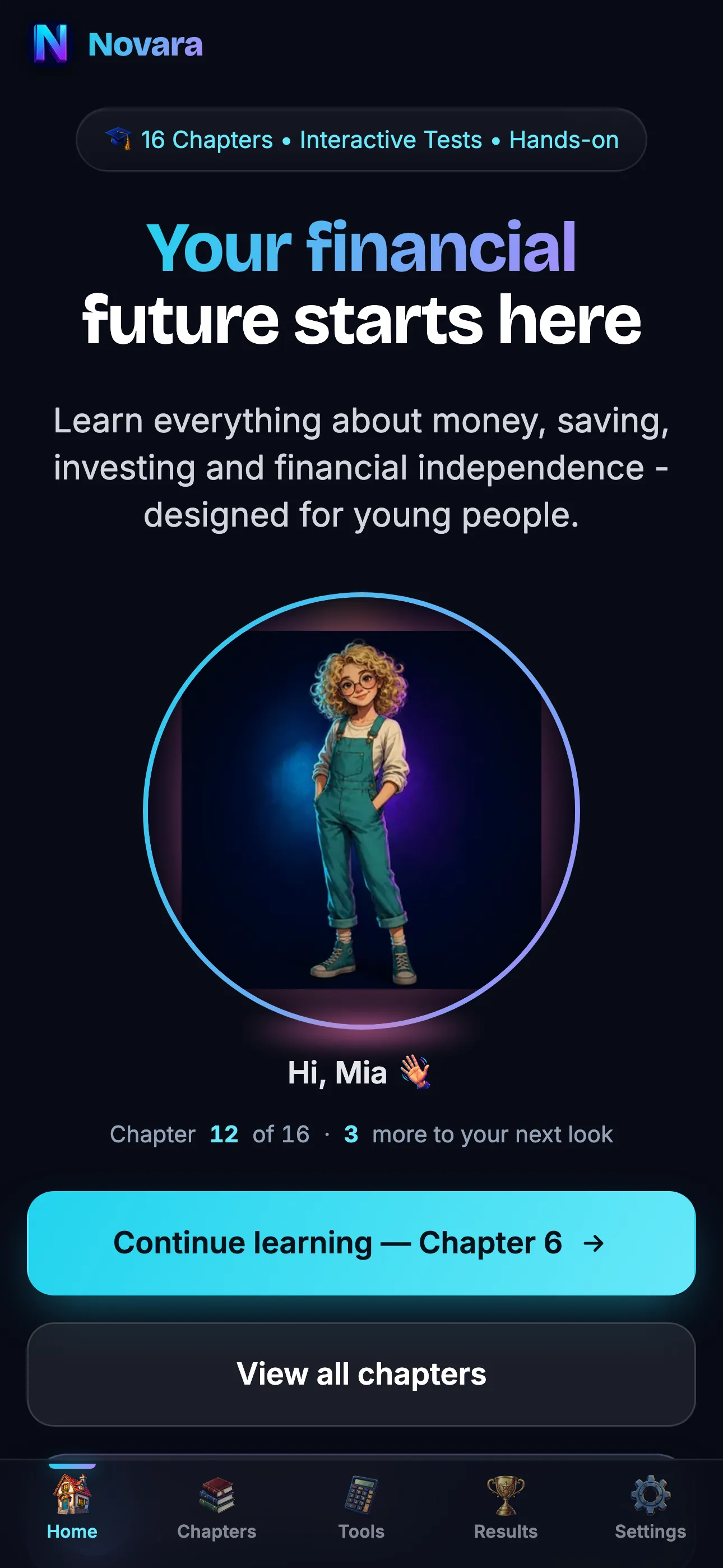
These twelve topics are, more or less, the chapters of Novara, the app I built for my daughters over that summer: 16 chapters from pocket money through interest, subscriptions, scams and the first payslip to credit, tax and investing, a quiz after every chapter, five calculators (compound interest, savings goal, budget and more) and a parent dashboard so you can see where your teen is. Free to download, the first three chapters are free, one purchase unlocks all 16 for the whole family. No ads, no subscription, no payment card. Rated 9+.
FAQ
What age should I start teaching my teen about money?
The plan works from about 13, when monthly allowance, a phone and a first bank card usually arrive. Younger children learn better with cash, a jar and the supermarket; older teens (16 to 17) can go through the plan faster and spend more time on weeks 8 to 12.
Do I have to tell my teen what I earn?
No. What matters is the structure: there is income, there are fixed costs, and what is left gets allocated. A payslip with the totals covered and a rough monthly plan are enough.
What if my teen is not interested?
Anchor every week to a real goal of theirs: the festival ticket, driving lessons, a laptop. Interest in money rarely comes from theory; it almost always comes from a want that costs money.
Sources
- GOV.UK: National Minimum Wage rates (link), Income Tax rates and Personal Allowance (link), Junior ISAs (link), ISAs (link)
- FSCS, deposit protection limit: fscs.org.uk
- U.S. Department of Labor, federal minimum wage: dol.gov
- IRS: tax year 2026 inflation adjustments (link), Topic 751 (link), IRA contribution limits (link), Form W-4 (link)
- FDIC, deposit insurance: fdic.gov
Maybe it’s useful for your family too.
Novara is the money course I built for my three daughters: 16 chapters, a quiz after each, calculators. The first chapters are free. One purchase opens the rest for the whole family. No ads, no subscription.